To watch the video please click on the link below:
https://www.youtube.com/watch?v=vNbaeDRCXTk
Twenty-five Years Ago: Remembering the Night “Operation Desert Storm” Was Launched on Iraq
January 17, 2016 at 10:52 pm | Posted in Turkmens | Leave a commentTags: Merry Fitzgerald, Operation Desert Storm
By Blue Woman

‘Operation Desert Storm’, the massive air and missile aggressionon Iraq was launched on January 17, 1991 at 2:30 a.m. local time.
That night as we were watching the TV, the programme was suddenly interrupted and we saw pictures of the Baghdad sky illuminated with what seemed to be anti-aircraft fire; we realized with horror that the war on Iraq had started. We stayed up all night, terrified, watching with dismay how beautiful Baghdad, the city of One Thousand and One Nights, was being massively bombarded.
Our thoughts and prayers were for our relatives and friends and for all Iraqis who could not escape from this hell. How many would die under the bombs and missiles which were falling ‘at random’ on residential areas all over Baghdad and other Iraqi cities?

I still shudder when remembering that awful night and all the other terrible nights of the ‘First Gulf War’, there was no possibility to communicate with our loved ones in Iraq, the U.S.’s first targets had been the telecommunication centres and electrical grid on which they had dropped Tungsten bombs. Iraqis were completely isolated, alone, desperately alone…in the dark…in the chaos, amidst the destruction caused by these brutal attacks from the air.
We watched in dismay how the beautiful country that many generations of Iraqis had worked so hard to build and develop was being destroyed. We watched with horror how the American and British ‘boys’ cheered whenever their bombs hit some ‘target’, killing Iraqis. No doubt that George Bush was enjoying it too, ‘bringing Iraq back to pre-industrial era’.

USAF F-117 : vampire in the Iraqi sky
Many Americans thought it was right to attack Iraq, they had no qualms that the country’s civil infrastructure was being purposely destroyed and that many thousands of Iraqis were dying. They believed the coalition troops were attacking Iraq to ‘liberate’ Kuwait* and to prevent an Iraqi attack on the zionist entity.
Some westerners who had never met an Iraqi and who could not even locate Iraq on the map, were filled with hatred towards the Iraqi people, because they had been told ‘how Iraqi soldiers were taking premature babies out of incubators in Kuwait’ !!! (1) and some other terrible stories fabricated by the western media,. Others were so gullible that they really believed there was such a thing as the ‘Iraqi Super canon’!!!
The western media were the accomplices of the warmongers, continuously diffusing their lies and propaganda. According to Fair,the US media allowed less than 1% of their space to those who were opposed the war. Day after day they repeated George Bush’s mantra: ‘about establishing a New World Order’ and many people in the west believed that the destruction of Iraq was worthwhile to establish this so-called ‘New World Order’.
Seventeen years have passed, but the pain and outrage I felt that night have not diminished, neither has my resentment towards all those who participated in this criminal aggression on Iraq.
George Bush, Dan Quayle, James Baker, Dick Cheney, William Webster, Colin Powell, Norman Schwarzkopf and many others who share responsibility in attacking and destroying Iraq still remain to be judged for crimes against peace, for war crimes, for crimes against humanity and for other criminal acts committed in violation of the Charter of the United Nations, in violation of the international law, in violation of the Conventions of Geneva and The Hague, in violation of the Charter of Nürenberg and in violation of the laws regulating armed conflicts. By waging this illegal war on Iraq George Bush also violated the Constitution of the United States.
Bush’s imperialist ‘New World Order’ was based on the capitulation and submission of the people in the Middle East, principally on the surrender of oil-rich Iraq.
On this sad seventeenth anniversary of the launching of the criminal aggression on Iraq my thoughts are with all Iraqi patriots who are fighting to free their country from the foreign occupiers.
On this day, one of the beautiful Irish patriotic song comes into my mind (I have substituted the name Ireland with Iraq)
Come the day and come the hour
Come the power and the glory
We have come to answer
Our Country’s call
From all the provinces of Iraq
Iraq, Iraq,
Together standing tall
Shoulder to shoulder
We’ll answer Iraq’s call
Hearts of steel
And heads unbowing
Vowing never to be broken
We will fight, until
We can fight no more
From all the provinces of Iraq
Merry Fitzgerald
(1) It was the daughter of the Kuwaiti Ambassador in the US who made these false accusations in front of the cameras, pretending to be a Kuwaiti nurse who had witnessed these barbaric acts!!!
*Kuwait: an invention of the British Foreign Office ‘around an oil well ‘ to deny Iraq access to the sea and so limit its influence in the Gulf and maintain it under British dependence.
The original source of this article is European Turkish Friendships
Copyright © Blue Woman, European Turkish Friendships, 2016
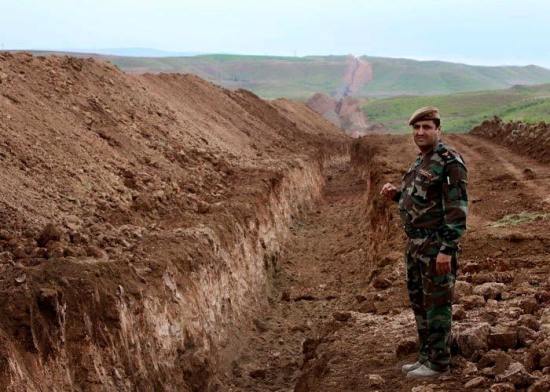
Kurds are illegally digging a trench in Northern Iraq to annex the Turkmen lands to the Kurdistan region
January 8, 2016 at 10:47 pm | Posted in Turkmens | Leave a commentKURDS ARE ATTEMPTING TO DE FACTO ANNEX THE SO-CALLED ‘DISPUTED TERRITORIES’ IN NORTHERN IRAQ TO THEIR AUTONOMOUS KURDISH REGION – THIS IS CALLED LAND-GRABBING!
PRESS RELEASE – by Turkmen Rescue Foundation media office
We would like to inform you about ongoing Kurdish attempts to kurdify all the turkmen lands:
– the Kurdish parties, started since months to draw the borders of the ‘Kurdistan region’ in northern Iraq by digging a 3 meter deep trench.
– The trench starts from Rabi’aa in Mosul near the Syrian border and ends in Jalula district – Diyala province at the Iraqi -Iranian border.
– This project is implemented with the support of international experts and it draws a border of new KRG through the GPS and it includes the ‘disputed areas’ in Article 140 of the Constitution.
– the operation is illegal because in 2013 the Regional Kirkuk Council’s decision to a build a trench surrounding Kirkuk province to protect the city from terrorist attacks, was refused by Iraqi Government at that time.
– It is important to note that the areas that fall within this border are beyond the control of the Iraqi government and the Iraqi army as well as Hashd al Shaabi.
– All Turkmen lands are situated within these borders.
Turkmen rescue foundation
Media office
@turkmenrescue
+9647826595401
Iraqi Turkmen representatives invited at the 6th European Parliament – Iraq Interparliamentary Meeting (VIDEO)
December 17, 2015 at 1:17 pm | Posted in Turkmens | Leave a commentTags: Ayden Hilmi Aksa, Dr Hassan Aydinli, Ershad Salihi, EU Parliament IRAQ interparliamentary mtg
Iraqi Turkmen representatives were invited at the 6th European Parliament – Iraq Interparliamentary Meeting – on 3rd December 2015.
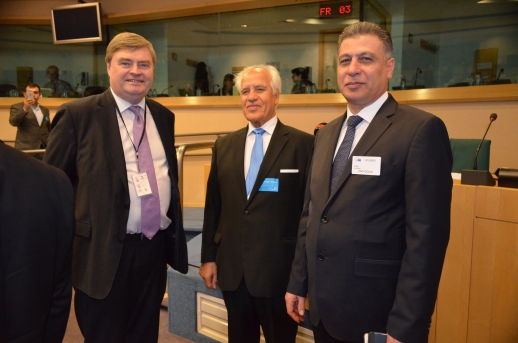
photo above: the Chair of the Delegation for relations with IRAQ, Mr. David Campbell Bannerman MEP – Iraqi Turkmen Front EU Representative Dr. Hassan Aydinli, and the President of Human Rights Commission at the Iraqi Parliament and ITF President, Mr. Arshad Salihi.
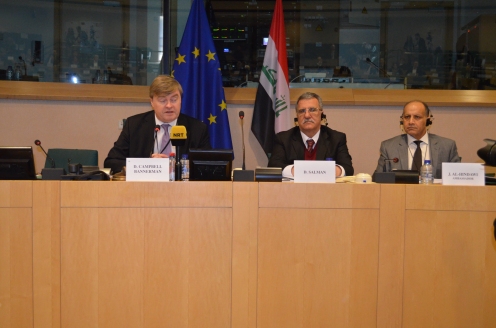
Introduction by the Chair of the Delegation for relations with IRAQ, Mr. David Campbell Bannerman MEP and by the Chair of the Iraqi Parliamentary Delegation, Mr. Dhafer Salman (see photo above) also on this photo H.E. the Ambassador of Iraq to the Kingdom of Belgium.
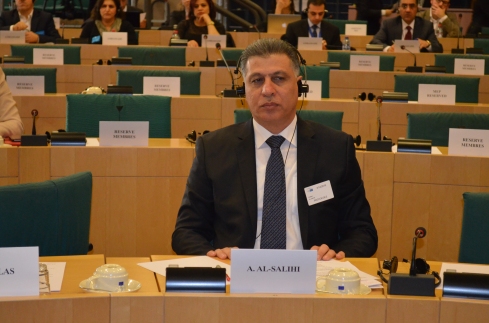
The President of Human Rights Commission at the Iraqi Parliament and ITF President Mr. Arshad Salihi
The recording of this event is available on: our multidevice player.
For Mr. Arshad Salihi’s speech please see at 2:10
Key speakers :
Mr. Elmark Brok, AFET Chair and AFCO Member
Mr. Yousif Mohammad Sadiq, Speaker of the Iraqi Kurdistan Regional Parliament
Mr. John O’Rourke, Head of Division Arabian Peninsula, Iran and Iraq at the European External Action Service
Mr. Struan Stevenson, former Chairman of the EP Delegation for Relations with Iraq.
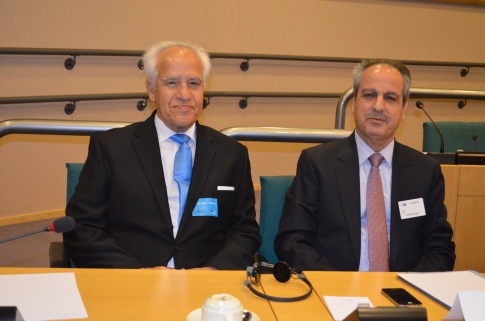
ITF EU representative Dr. Hassan Aydinli and Mr Ayden Hilmi Aksa, Foreign Relations Advisor Republic of IRAQ Council of Representatives.
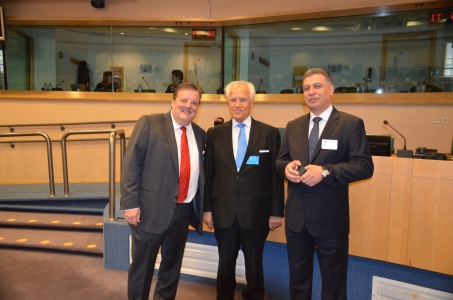
Mr. William Spencer, Intl. Institute for Law and Human Rights, Executive Director, Iraqi Turkmen Front EU representative Dr. Hassan Tawfiq Aydinli and the President of Human Rights Commission at the Iraqi Parliament and ITF President Mr. Arshad Salihi
please find the links to the web-streaming recording hereunder:
http://www.europarl.europa.eu/ep-live/en/other-events/video?event=20151203-0930-SPECIAL
This event is also available on our multidevice player.
Iraq’s Turkmen on their own By Nermeen Mufti
November 3, 2015 at 2:11 am | Posted in Turkmens | Leave a commentTurkmen are Iraq’s third largest ethnic group but they remain underrepresented in politics and their plight is largely ignored.
Baghdad – Iraq’s Turkmen are the country’s third largest ethnic group after Arabs and Kurds but the community of nearly 3 million people has endured displacement, isolation, discrimination and violence throughout its history.
Today, the Turkmen remain underrepresented in Iraqi politics and their plight is largely ignored. Please click on the link hereunder:
The Kurdish Terror Campaign in Turkmen Eli (video) by Salman Mofak
November 3, 2015 at 1:30 am | Posted in Turkmens | Leave a commentThe Kurdish Terror Campaign in Turkmen Eli (video) by Salman Mofak
After the fall of Saddam Hussein government the Turkmen, Arabs, and Chaldo Assyrians had high expectations of the interim administration established after 9th April 2003.
The Turkmen expected to see democracy, fairness, an end to discrimination, the right to self-determination and an end to violence. Unfortunately, the opposite has occurred regarding the human rights situation in Iraq, in particular concerning the Iraqi Turkmen. After the toppling of Saddam Hussein in 2003, hundreds of Kurdish militia poured into the Turkmen city of Kirkuk.
The Kurdish militia ransacked the municipality buildings in Kirkuk, government offices and military buildings.
The land deeds belonging to the Turkmen were deliberately taken from the Registry Office making it difficult for the Turkmen to establish themselves as original inhabitants of the province.
Large hotels, hospitals and a historical military barracks in the city (at that time used as a museum), which was built in the Ottoman era, along with Turkman shops and houses, including the land registry office were set alight by the Kurdish militia.
The invasion of Kirkuk in 2003 by the Kurdish militia was a mirror image of the events from 1991 during the uprising against Saddam Hussein after Operation Desert Storm.
Thousands of internally displaced Kurds and Turkmen returned to Kirkuk and other Arabised regions to reclaim their homes and lands that had been occupied by Arabs from central and southern Iraq. These returnees had been were forcibly expelled from their homes by the government of Saddam Hussein during the 1980s and 1990s.
The majority of the returning Kurds were not originally from Kirkuk but were brought to Kirkuk with the help of the two Kurdish parties and they were housed in the vacant Turkmen and Arab houses.
The reasoning behind this was that they wanted to change the demography of the city and win the referendum that was planned to be carried out by 31 December 2007 to determine whether Kirkuk could formally join the Kurdish administered region, an outcome that Arabs and Turkmen in Kirkuk staunchly opposed.
Salman Mofak.
Dr. Hassan Aydinli, ITF EU Representative and Mr. Niyazi Mimar Oğlu, Member of the Iraqi Council of Representatives at the European Parliament
October 24, 2015 at 9:11 pm | Posted in Turkmens | Leave a commentTags: Dr Hassan Aydinli, European Parliament Strasbourg, Mr Niyazi Mimar Oglu

Dr. Hassan Aydinli, Iraqi Turkmen Front EU Representative and Mr. Niyazi Mimar Oğlu, Member of the Iraqi Council of Representatives were invited as guest speakers at the Delegation for Relations with Iraq Meeting at the EU Parliament in Strasbourg.


Hereunder the official Minutes of the Meeting:
DELEGATION FOR RELATIONS WITH IRAQ MEETING AT THE EUROPEAN PARLIAMENT
D-IQ_PV(2015)0610
MINUTES
of the meeting of 10 June 2015, 15.00-17.00
The meeting opened at 15.00 on Wednesday, 10 June 2015, with David Campbell Bannerman (Chair) presiding.
1. Chair’s announcements
Mr Brian Hayes (EPP – IRELAND), welcomed guest speakers from the Yazidi, Turkmen and Chaldean/Syriac/Assyrian communities in Iraq. He reminded the audience that the EU supports those actors who promote national reconciliation processes in Iraq, including Iraqi institutions promoting the creation of an inclusive Iraqi National Guard. In this regard, he announced that he recently met with the Speaker of the Iraqi Council of Representatives, Mr Al-Jabouri, at a joint AFET-DEVE meeting dedicated to the humanitarian response plan for Iraq. The outcome of this meeting was positive.
2. Adoption of draft agenda (PE 553.741)
The agenda was adopted.
3. Adoption of minutes of the Delegation meeting of 29 April 2015 (PE 553.735)
The minutes were adopted.
4. Exchange of views with the Representatives of the ‘Yazidi Democratic Movement’ in Sinjar, created for the fight against Daesh:
Mr. Said Hassan, a representative of the ‘Yazidi Democratic Movement’, argued that the different peoples living under dictatorships in the MENA region were forced to protest against their respective regimes, a phenomenon commonly known as the Arab Spring. Unfortunately, this phenomenon, he explained, generated a situation in Iraq that threatens the survival of Iraqi minorities. Subsequently, he called upon EU institutions and the UN Security Council to focus on Iraqi minorities under risk of disappearing, particularly the Yazidi community.
In August 2014, DAESH killed thousands of Yazidi men in Sinjar. This massacre, among others, is part of DAESH’ destruction of Iraqi heritage, an action that will result, in his opinion, in a major cultural loss. In this regard, he thanked the Kurdish people for helping the Yazidi community, which, he claimed, might face extinction. In order to avoid such extinction, a constituent assembly has been established to govern the Yazidi community in Mount Sinjar and the surrounding territories. Another governing body has been established outside of Iraq to support Yazidi efforts inside Iraqi territory, he explained.
Then, he argued that the Yazidi community has had to resort to the creation of its own forces, as Iraqi forces do not guarantee their security. In March 2015, the Yazidi community formed its own forces, which now operate in Sinjar. According to him, if they had had more weapons and military backup, they could have hired more people to fight against DAESH. He called upon the international community and the EU to support the Yazidi forces, as it is not acceptable to permit the extinction of ancient minorities such as the Yazidi community.
Mr. Nouri Mirza, a member of the ‘Yazidi Democratic Movement’, thanked the EU for inviting Yazidi representatives to speak about their current situation in Iraq. He argued that the international community is paying little attention to the Yazidi community, which is suffering DAESH’ atrocities, among them the Sinjar massacre. As a board member of the Yazidi Democratic Movement, he stated that the conditions faced by the Yazidi community are severe. He explained how this community has been displaced through Iraq, Syria and Turkey. According to statistics, more than 5.000 Yazidi people have been kidnaped by DAESH; most of them women and children. Also, 11 massive graves have been found containing bodies of Yazidi people, and the holy places of this community have been destroyed by DAESH.
He then provided an example: in August and September 2014, DAESH militants in northern Iraq perpetrated a massacre in the village of Kocho, and abducted women and children. Before said event, there were 344 Yazidi families living in Kocho, that is 1738 Yazidi people. From this amount of people, over 450 were killed by DAESH militants.
He called upon the international community to help Yazidi refugees. He thanked the Iraqi Kurdistan for hosting the Yazidi community, which has been settled in camps. The conditions in these camps are not proper; he argued. Refugees lack access to medical health care, being diseases common. Also, over 10.000 people are hiding in the Sinjar Mountain receiving no help from the international community. They have no water, tents, weapons, nor clothing.

5. Exchange of views with the representatives of minority communities in Iraq:
Mr David Campbell Bannerman (ECR-UK, Delegation Chair), resumed his role as Chair of the Delegation.
Dr. Hassan Tawfiq Aydinli, Iraqi Turkmen Front EU Representative, thanked the EU for inviting Iraqi representatives to speak for an EU audience. He focused his contribution on two of the main problems faced by Turkmen in Iraq. Turkmen have been twice internally displaced people: first under Saddam Hussein, and now under DAESH. This has led to the loss of property. Reclaiming this property is difficult. There is a Commission in charge of handling confiscations, properties and related topics. Nevertheless, due to administrative difficulties and the advance of DAESH, it has proven almost impossible for Turkmen to regain their property. The other problem is the following: 300.000 Shia people belonging to the Turkmen community have been forced to leave the community, as DAESH attacks the Shia community. Defending the Shia Turkmen community is causing the death of Turkmen, who receive no help from the Iraqi government nor the Peshmerga.
Mr. Niyazi Mimar Oglu, a member Iraqi Council of Representatives who has been targeted 28 times, also thanked the EU for inviting Turkmen representatives to discuss the concerns of this community. This community, he explained, is composed of over 2 million people. It faces DAESH, and the differences between the government in Baghdad and that in the Kurdish region. Many people have been killed, and many others have been forced to flee. Others have been kidnapped.
The Turkmen believe in diplomacy, in formal negotiations, he argued. However, given the circumstances, the Turkmen have been forced to fight. The international community has ignored the difficulties faced by this community, he emphasised. Also, the rights of this community have been violated, and their territory -under the umbrella of the central government-, reduced.
He sought to obtain international support for the Turkmen community, and explained the need for stronger military action against DAESH. Also, he stated that, from the entire EU funding to Iraq, the Turkmen did not receive an euro.
Mr. David Campbell Bannerman (ECR-UK, Delegation Chair) thanked the Turkmen guests for travelling to EU and for their contributions.

with Mr. Brian HAYES, Fine Gael MEP for Dublin, Ireland.
Member of the European People’s Party.

He then gave the floor to Assyrian representatives.
Mr. Sharbil Hanna Matty, General of the Assyrian “Nineveh Plain Forces”, thanked the EU for the invitation to participate in the meeting. He referred to the Assyrian people as a Christian nation looking for co-existence in Iraq, partnership and equal rights. He thanked the Kurdistan region for hosting all types of refugees, and urged the EU to support the Kurdish government and to implement all the measures promised by the EU. They have received no military support. The Peshmerga is currently training Christian Assyrian forces, yet this is not enough. They need weapons; vehicles and clothing.
Furthermore, he stated that the Assyrian community seeks to become an independent administration within the Kurdistan region. Also, he expressed his support to other minorities and the willingness of the Assyrian community to work with other communities towards a common project, that is, a unified and democratic Iraq. In order to achieve this project, he explained, the support of the European Union is needed. The EU needs to be involved in the negotiations so that minorities are conceived of as equal partners, and so that displaced people feel like returning to their homes.

MPE Mr. Gérard Deprez (Group of the Alliance of Liberals and Democrats for Europe, Belgium) welcome the willingness of the different minorities to work together towards an end of the conflict. He then requested a clarification on whether these minorities are seeking any sort of political or territorial autonomy. Also, he noted that, despite the fact that all minorities feel part of Iraq, all the representatives thanked the Peshmerga or the Kurdistan region rather than the Iraqi forces or the central government. He asked what the Iraqi government could do for these minorities; and whether the Iraqi government can guarantee their security.
MPE Mr. Afzal Khan (Group of the Progressive Alliance of Socialists and Democrats in the European Parliament, United Kingdom) asked the representatives of these minorities about the emergence of DAESH. Other MPE enquired about the deplorable situation in Kurdistan, and, in line to Mr. Khan’s question, asked about the emergence and success of DAESH, which is seen as a protector of the Sunni people.
The representatives argued that their demand for autonomy was not new, but a demand that was formulated in 2004 following the fall of the Saddam regime. This autonomy is supported by the Iraqi constitution, they explained, and does not imply the division of Iraq, but the creation of autonomies within Iraq. The representatives of these minorities argued that minorities look forward to have their own administrations and to achieve equality, and that they support each other in their aspirations. They also asserted that, when it comes to autonomy, all the difficulties faced by the different communities in Iraq are rooted in the creation of Iraq following World War I. They argued that if one part of Iraq is allowed to have its own autonomy, so do other parts.
Furthermore, they argued that the Iraqi government does not have the capacity to rule the country, and that minorities do not receive help from the central government. These minorities are settled between DAESH and the Kurdish region. Consequently, following the fall of the Saddam regime, the Kurdish region became the ally of these minorities, who ask for equal access to help.
In regard to the emergence of DAESH, they argued that it is an organisation that rose in a space where it could expand itself. Also, there is a theory that DAESH has been created in order to design a new Middle East map. Anyway, they argued, the different parties in Iraq were not able to coordinate themselves, particularly with the Iraqi government, making it difficult to act cohesively against DAESH. Moreover, they underlined that people joining DAESH do so because they have not been able to find a place within their respective countries, from Saddam’s former military heads in Iraq to European militants joining the ranks of DAESH.
Finally, the called upon the EU to support internally displaced people as well as the reconstruction of Iraq. They called for resolutions to be implemented. They argued that people is losing hope in the international community.
A representative from the Iraqi Embassy argued that Iraq is a democratic country, since all minorities do have representatives in the central government. He argued that these representatives should express their concerns to their elected members of parliament. Iraq has financial issues, and this has to be taken into consideration.
6. Any other business
None.
7. Date and place of next meeting
The meeting closed at 17.00.
The following MEPS attended the meeting:
David Campbell Bannerman, Brian Hayes, Javier Couso Permuy, Joëlle Bergeron, Gérard Deprez, Ana Gomes, Michel Reimon, Afzal Khan, Branislav Škripek, György Hölvényi, Bas Belder
Dr. Hassan Aydinli, ITF EU representative received an invitation from MEP Josef Weidenholzer to participate to the Conference on Human Rights in Iraq at the EU Parliament
July 2, 2015 at 11:52 am | Posted in Turkmens | Leave a commentDr. Hassan Aydinli, Iraqi Turkmen Front EU representative was invited as speaker at the Conference on Human Rights and religious minorities in Iraq, which was hosted by MEP Josef Weidenholzer at the European Parliament on 29th – 30th June and 1st July 2015.

MEP Josef Weidenholzer, Chairman of the Conference and Dr. Hassan Aydinli, Iraqi Turkmen Front EU representative.
Were present at the conference opening:
H.E. Dr. Jawad Al-Chlaihawi, Designated Ambassador of Iraq in Belgium
Delavar Ajgely, Head of the Mission to European Union, KRG
Breen Tahseen, Yazidi representative of the ‘Mir’ family, Iraqi Diplomat
Several Members of the European Parliament participated at the Conference.
Marietje Schaake (ALDE), Ana Gomes (S&D), Cornelia Ernst(GUE), Michèle Alliot-Marie Former State Minister (France),Ismail Ertug, Engel Frank, Freund Eugen, Afzal Khan, Barabara Lochbihler, Martin Edouard, Piri Kali, Reimon Michel, Terricabras Josep-Maria, Zaborska Anna.
Alessia Corsini, European Commission
Thomas Schmidinger, Humanitarian Organisation LeEZA, University Vienna

Participants :
Hassan Aydinli, Iraqi Turkmen Front EU representative
Jamil Suleiman Haydar, Former Minister of Agriculture and Water Resources Iraq
Mirza Dinnayi, Head of “Air Bridge” Iraq & KRG Advisor for Disputed Areas in Iraq
Yonadam Yawsep Kanna, Iraqi Parliament, Assyrian Democratic Movement (ZOWAA)
Yousuf Muharam Salman, Shabak Democratic Gathering in Europe, Iraqi Minorities Council
Hasan Nagham, Gynaecologist and volunteer aid worker for an NGO in Iraq
Emanuel Youkhana, Archimandrite, Head of CAPNI (Christian Aid Program Northern Iraq)
Mato Naif, Mayor Kojo (village massacred by IS)
Salam Farhan, Director of Mandaean Human Rights Group
Hayder Shesho, HPS (Shingal’s protection units)
Mamou Farhan Othman, Director of the European Studies Centre, Univesity of Duhok
Leyla Ferman, Co-President of the Yezidi Federation of Europe
Diya Butrus Sulaywa, Head of Independant Commission for Human Rights, Kurdistan
Naher Arslan, Assyrian Institute of Belgium
Lokman Khalil, Shabak, Netherlands
Goran Alkakay, Kakai-Intellectual, Nineveh Plains
Shuhaib G. Nashi, Mandaen Association Union, Morristown, NJ
Hagop Simonian, Armenian Community Arbil

Dr. Hassan Aydinli spoke on the Political and Humanitarian Situation of Turkmens

The panel was chaired by Michiel Leezenberg, University Amsterdam


Dr. Hassan Aydinli speaking with Michèle Alliot-Marie, MEP, Former State Minister, Head of the Parliamentary Working Group ‘Christians in the Middle East”, France.


The conference was followed by ‘Working Groups’ during which the participants had a chance to discuss the following questions in smaller groups:
1. Which political solutions are there for the minorities in Iraq that are threatened by IS and other militias?
2. What can the European Union do to support such solutions?
3. Which humanitarian measures would you ask from the EU?

Dr. Hassan Aydinli and MEP Josef Weidenholzer


A Joint Press Meeting took place in the Glassroom at the EP on 1st July 2015.
Moderations and Introduction : MEP Josef Weidenholzer.
participants:
Mirza Dinnayi, Head of “Air Bridge” Iraq & KRG Advisor for Disputed Areas in Iraq
Hassan Aydinli, Iraqi Turkmen Front EU representative
Yonadam Yawsep Kanna, Iraqi Parliament, Assyrian Democratic Movement (ZOWAA)
Yousuf Muharam Salman, Shabak Democratic Gathering in Europe, Iraqi Minorities Council
Hasan Nagham, Gynaecologist and volunteer aid worker for an NGO in Iraq
Emanuel Youkhana, Archimandrite, Head of CAPNI (Christian Aid Program Northern Iraq)
Mato Naif, Mayor Kojo (village massacred by IS)
Salam Farhan, Director of Mandaean Human Rights Group

This is the second time Dr. Hassan Aydinli, ITF EU representative was invited at the EU Parliament this month to speak about the Turkmens of Iraq, please see:
Two Iraqi Turkmen representatives, were invited as guest speakers at the EU Parliament in Strasbourg, at the Delegation for Relations with Iraq Meeting on 10th June 2015
http://turkmenfriendship.blogspot.be/2015/07/dr-hassan-aydinli-iraqi-turkmen-front.html
Dr. Hassan Aydinli, Iraqi Turkmen Front EU Representative and Mr. Niyazi Mimar Oğlu, Turkmen Member of the Iraqi Parliament were invited as guest speakers at the European Parliament
July 1, 2015 at 6:28 pm | Posted in Turkmens | Leave a commentDr. Hassan Aydinli, Iraqi Turkmen Front EU Representative and Mr. Niyazi Mimar Oğlu, Turkmen Member of the Iraqi Parliament were invited as guest speakers at the Delegation for Relations with Iraq Meeting at the European Parliament in Strasbourg, France on 10th June 2015.
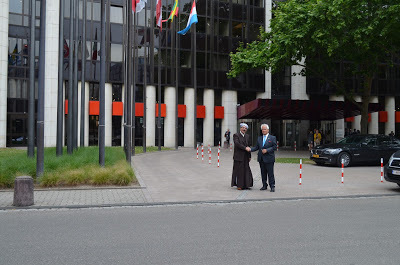
Niyazi MIMAR OĞLU, Turkmen Member of the Iraqi Parliament.
Dr.Hassan Aydinli, ITF EU Representative
in Front of the EU Parliament in Strasbourg, France.

From left to right: Brian HAYES, Vice-Chairman Delegation for relations with Iraq
David CAMPBELL BANNERMAN, Chairman of Delegation for relations with Iraq
Niyazi MIMAR OĞLU, Turkmen Member of the Iraqi Parliament
Dr. Hassan AYDINLI, Iraqi Turkmen Front EU representative

From left to right: Brian HAYES, Vice-Chairman Delegation for relations with Iraq
David CAMPBELL BANNERMAN, Chairman of Delegation for relations with Iraq
Niyazi MIMAR OĞLU, Turkmen Member of the Iraqi Parliament
Dr. Hassan AYDINLI, Iraqi Turkmen Front EU representative

Brian HAYES, Vice-Chairman of the Delegation for relations with Iraq
Dr.Hassan AYDINLI, Iraqi Turkmen Front EU representative
Niyazi MIMAR OĞLU, Turkmen Member of the Iraqi Parliament

From left to right: Branislav Skripek MEP.
Dr.Hassan Aydinli, ITF EU Representative.
David Campbell Bannerman, Chairman of the Delegation for relations with Iraq.
Niyazi MIMAR OĞLU, Turkmen Member of the Iraqi Parliament.
Javier Couso Permuy, Vice-Chairman of the Delegation for relations with Iraq
Afzal Khan, Member of the European Parliament
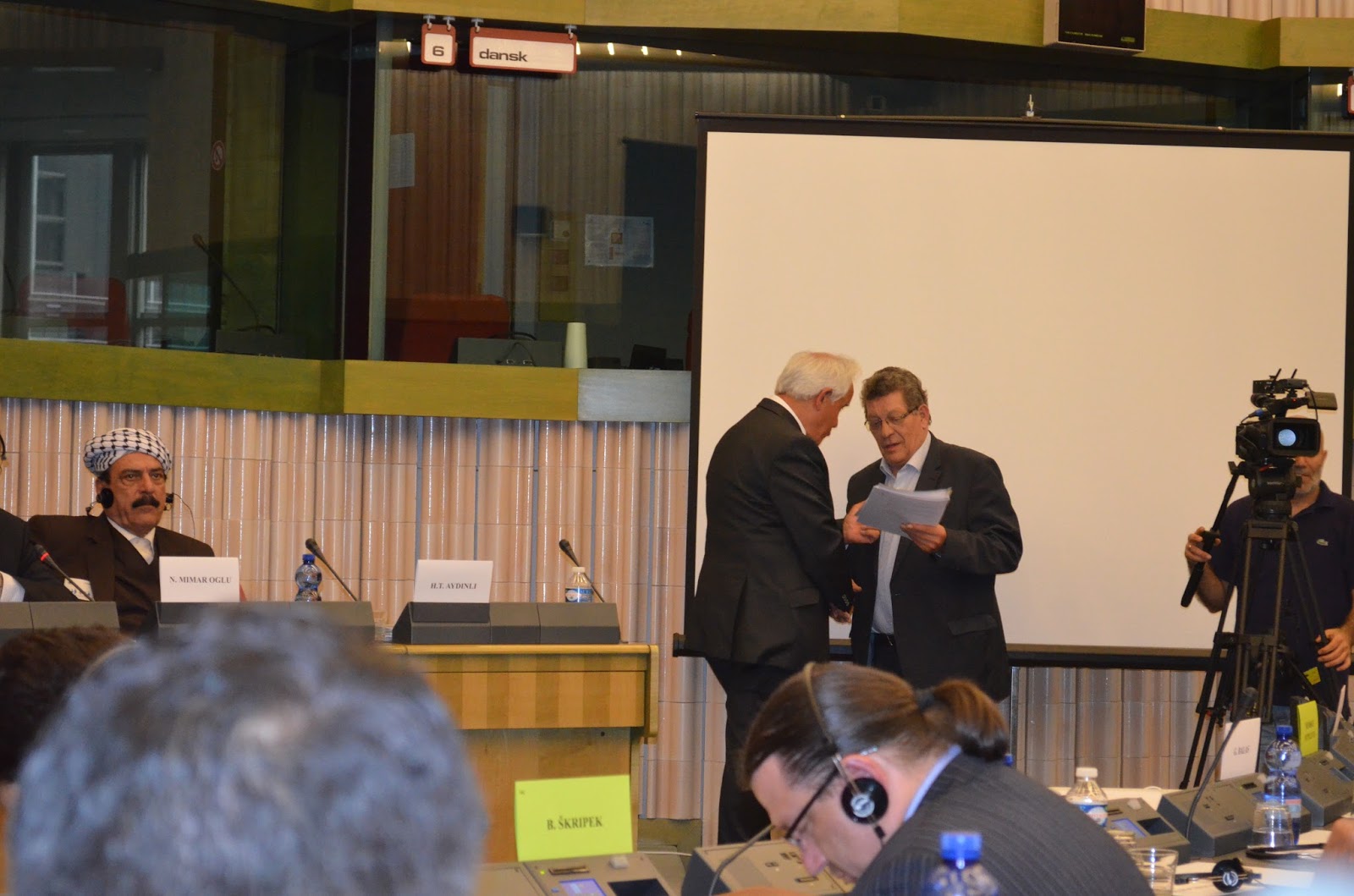
Dr. Hassan Aydinli, ITF EU Representative speaking to
Gérard Duprez, Member of the European Parliament

Javier Couso Permuy, Vice-Chairman of the Delegation for relations with Iraq
David Campbell Bannerman, Chairman of the Delegation for relations with Iraq.
Niyazi MIMAR OĞLU, Turkmen Member of the Iraqi Parliament.
Dr.Hassan Aydinli, ITF EU Representative

Rok KOZELJ, EU Parliament Directorate General External Policies
Brian HAYES, Vice-Chairman of the Delegation for relations with Iraq
David Campbell Bannerman, Chairman of the Delegation for relations with Iraq.
Niyazi MIMAR OĞLU, Turkmen Member of the Iraqi Parliament.
Dr.Hassan Aydinli, ITF EU Representative


Several MEPs attending the conference put questions to
the guest speakers
from left to right MEPs Bas Belder, Branislav Skripek, Afzal Khan.

Many Members of the EU Parliament and representatives of EEAS
attended the conference
Michel Reimon, Ana Gomes, Gérard Deprez, J. Bergeron,
Branislave Skripek, Bas Belder, Afzal Khan and others.


Branislav Skripek, Member of the European Parliament
Dr. Hassan Aydinli, Iraqi Turkmen Front EU representative

Dr. Hassan Aydinli, Iraqi Turkmen Front EU representative
Afzal Khan, MEP

Afzal Khan, MEP, Dr. Hassan Aydinli ITF EU representative
Niyazi MIMAR OĞLU, Turkmen Member of the Iraqi Parliament.

Niyazi MIMAR OĞLU, Turkmen Member of the Iraqi Parliament
Dr.Hassan Aydinli, ITF EU Representative
in Front of the Council of Europe in Strasbourg, France.
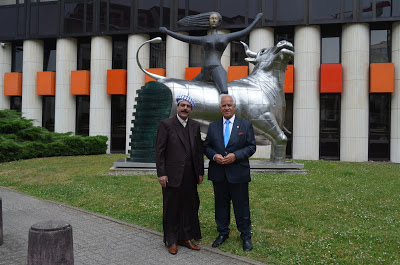
Niyazi MIMAR OĞLU, Turkmen Member of the Iraqi Parliament.
Dr.Hassan Aydinli, ITF EU Representative
in Front of the EU Parliament in Strasbourg, France.
Iraq’s Shia Turkmen militia counterattack in Bashir
June 13, 2015 at 9:21 am | Posted in Turkmens | Leave a commentTags: BASHEER, Beshir, Shia Turkmen
Pissed Off Turkmen Want Their Town Back
Iraq’s Shia Turkmen militia counterattack in Bashir
by MATT CETTI-ROBERTS
An Iraqi Turkmen militiaman stands on a black Ford F250 Super Duty and stares off into the distance. Above there’s the hazy midday sun. In front of him, there’s the front line in the war with Islamic State.
Three Islamic State fighters approach the front line — a sandy berm stretching into the distance on either side of the miltiaman’s position. IS is notorious for using teams of suicide bombers, so the Turkmen fighter cannotallow them to get close.
Reaching toward the truck’s mounted KPV 14.5-millimeter heavy machine gun, he racks back the cocking handle, swivels the weapon toward no-man’s land and fires three short bursts.
The militants scatter back the way they came.
It’s early April and beyond the earthen berm, less than a mile away, is the Islamic State-held town of Bashir. The town sits around 10 miles southwest of Kirkuk.
The fighters occupying the front line here are mainly Shia Turkmen from the local area working as part of Iraq’s predominantly Popular Mobilization Forces — also known as the Hashd Shaabi.
In a few days, they will carry out another attack to retake the town.
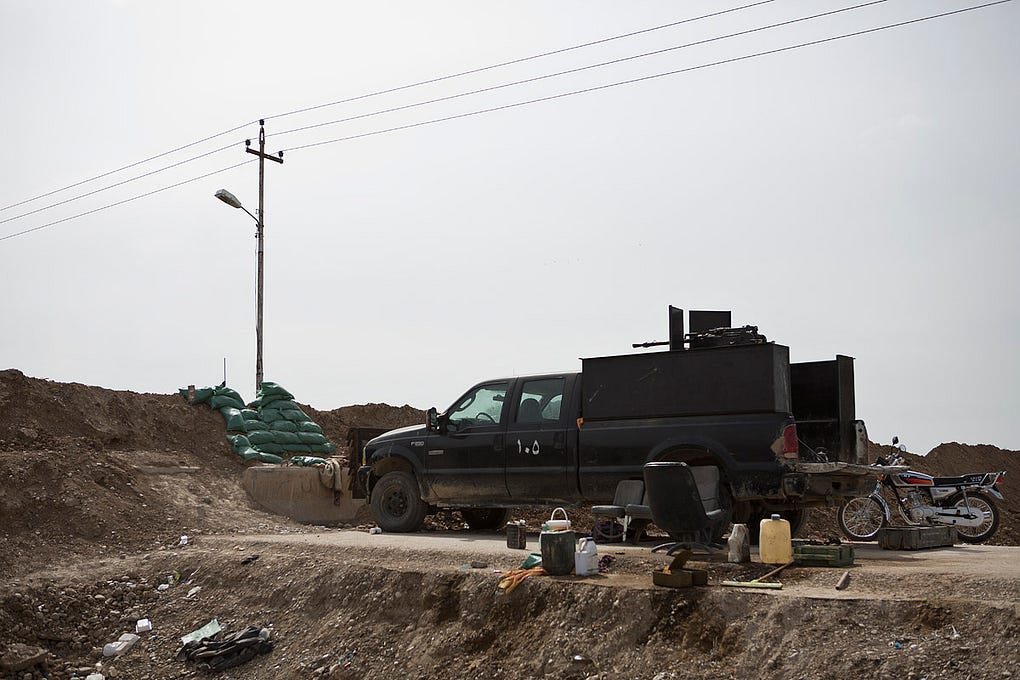
At top — a Shia Turkmen fighter of the Martyr Sadr Force stands on the roof of his unit’s base near Kirkuk. Above — a Badr Organisation position at the front line outside Bashir. Matt Cetti-Roberts photos
The Turkmen are one of Iraq’s largest minority groups, descended from various waves of migration dating back to the 7th century. Although they inhabit areas across central Iraq, many lived in villages to the south of Kirkuk before Islamic State came.
Bashir is widely considered the heart of the Iraqi Turkmen community. They once constituted 40 percent of its population.
But in 2014, Islamic State swept through Iraq. In June, Bashir fell. Iraqi army troops based at the nearby K-1 Airbase fled, and left their weapons and vehicles behind. The Kurdish Peshmerga rushed in to fill the security vacuum in and around oil-rich Kirkuk.
One of the Iraqi army troops who fled is now back. Maj. Abdul Hussein Abass sits behind a desk inside a base for the Hash Shaabi’s Martyr Sadr Force.
Shia religious flags fly from the roofs of the base’s buildings. “When ISIS took Bashir, 23 people were killed, including women and children,” Abdul says — while surrounded by Turkmen Shia fighters.
“I am from Bashir originally,” Abdul, who is Turkman Shia himself, says. “It’s my neighborhood, so I joined the fight. I am a military man.”
“We are here to protect our land, especially Turkman Shia, [but] we don’t have racism,” Abdul says. “We are all here. There aren’t many of us so we have to work together. Ten Sunni guys joined, we never say no.”
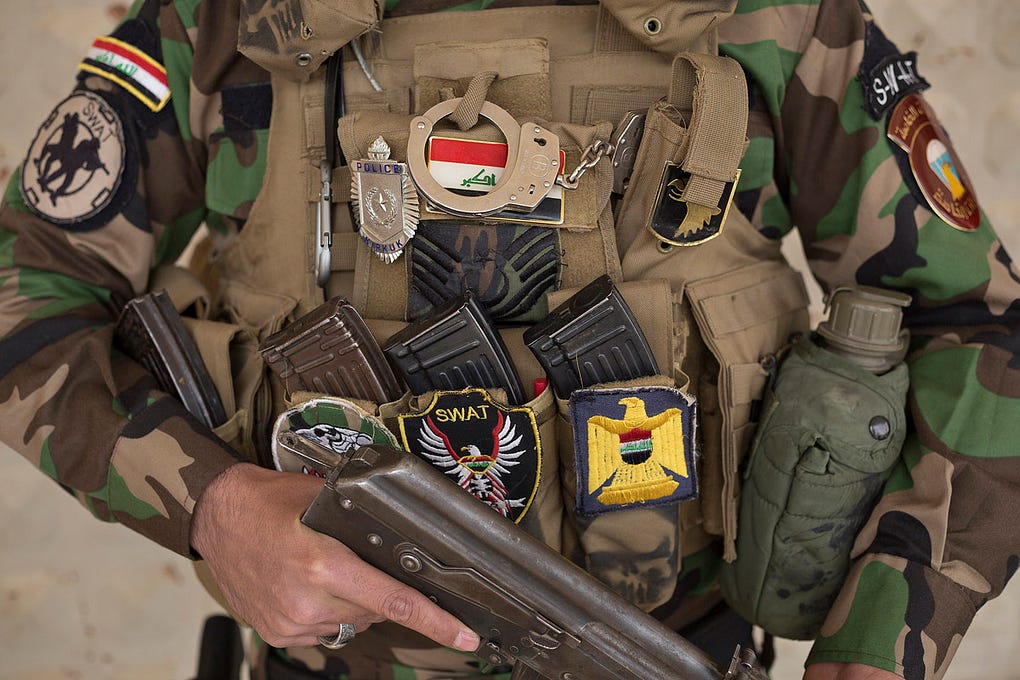
The badge-adorned load carrying vest of a Turkmen Martyr Sadr Force fighter. Matt Cetti-Roberts photo
Abdul says that improvised explosive devices — or IEDs — are a major obstacle to retaking the town.
“When we say we will take Bashir, the fighters move and don’t think there are bombs,” Abdul says. “They are all thinking of the fatwa, it is inside their brain pushing them to this kind of work.”
After his unit evaporated during the Islamic State advance last year, he moved to the Kurdish capital of Erbil and registered to join Unit 16 — the Turkmen Hashd Shaabi formation that covers the area from Tuz Khumartu to Kirkuk.
From there, he helped liberate the besieged Turkmen town of Amerli in September 2014.
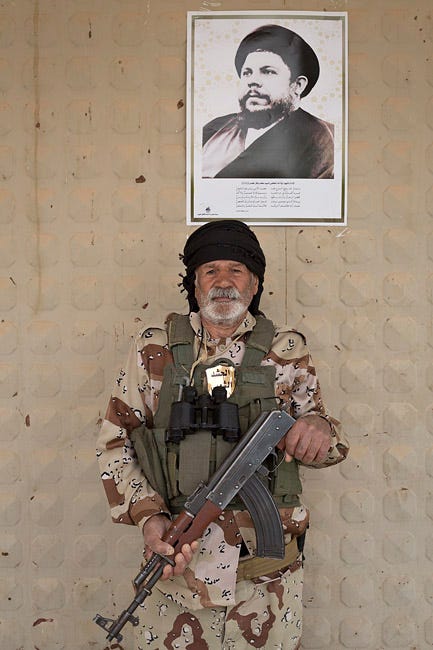
A Shia Turkmen fighter of the Martyr Sadr Force stands beneath a portrait of Muhammad Baqir Al Sadr, a Shia cleric executed in 1980 by the Ba’athists, at the unit’s base near Kirkuk. Matt Cetti-Roberts photo
On June 29, 2014, Abdul took part in the first attack on Bashir, where 26 Turkmen died. He tells us that the fighters were not organized properly — unlike now under the Hashd Shaabi.
But this isn’t the first time Bashir’s residents were forced from their homes.
In 1986, Saddam Hussein’s Arabization policy displaced the town’s Turkmen. The plan was to bring in loyal Sunni tribes to areas where minority groups who opposed the regime flourished.
“I remember I was in the sixth grade, I didn’t pass that year of school,” Abdul recalls. “They [the Iraqi army] said the sewage pipes didn’t work so we couldn’t stay in Bashir — then they gave it to to the Sunni Arabs.”
When American forces invaded in 2003, the Turkmen returned from exile to reclaim their homes. Fighting between returning Turkmen and Sunni Arabs eventually saw Saddam’s emigres forcibly ejected.
Many Sunnis remained in the outlying villages and some joined Islamic State. “Whoever was working with ISIS of course can’t come back home [and] has to go to prison, we have names and intelligence of these people,” Abdul adds.
“We are from this land and trying to protect this land. We are trying to defend Bashir, because it is our land, our property,” he says, explaining why only the Shia Turkmen are trying to liberate the town.
He also doesn’t see Unit 16 having a role in any future liberation of Mosul — a majority Sunni city. He believes former residents of the city should be involved in the operation instead.
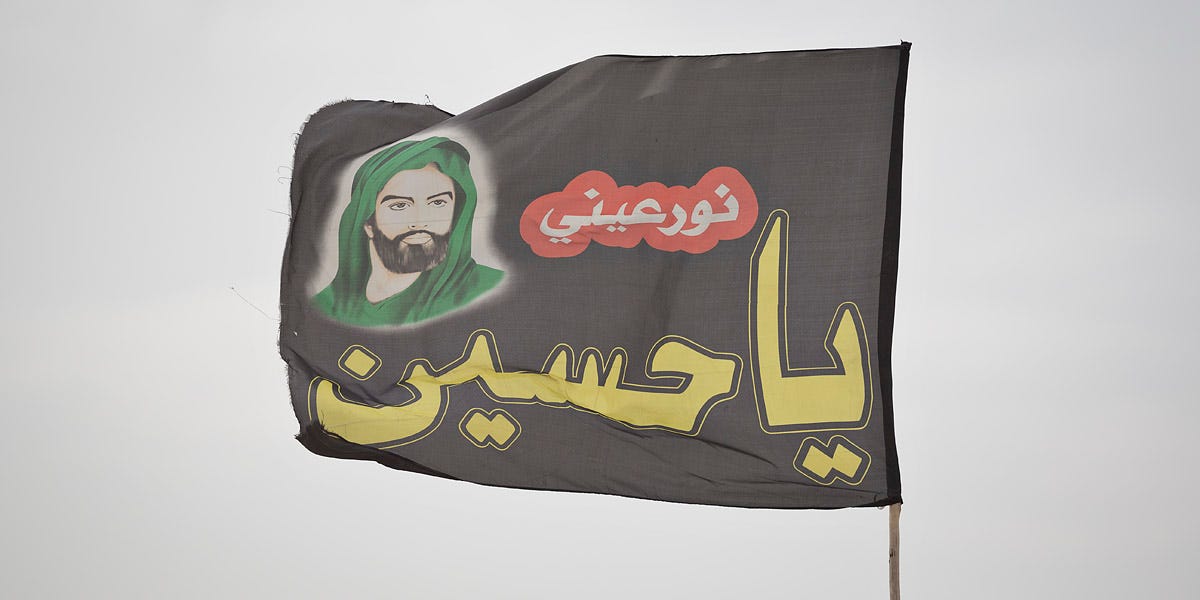
A militia flag. Matt Cetti-Roberts
Reprisals
Colorful flags of Iraq’s powerful Shia forces flutter along the front line. On the walls of the Martyr Sadr Force’s base are pictures of Muhammad Baqir Al Sadr, a Shia cleric executed in 1980 by Saddam’s Ba’athist regime.
But the Shia militias’ sectarian nature has provoked fears of retribution attacks against Sunnis. Iraq’s mainly Shia Popular Mobilization Forces were brought together by a fatwa — a religious call to arms — by Grand Ayatollah Ali Al Sistani.
In 2014, Iraq’s then-Prime Minister Nouri Al Maliki authorized the miitias’ deployment and gave them official backing. The militias have since been at the forefront of victories over Islamic State, beating them back in Diyala province and parts of Salahaddin.
But human rights groups have accused Shia fighters of carrying out sectarian attacks against Sunnis — looting homes, setting property on fire and carrying out executions.
There’s even been recurring friction between the Hashd Shaabi and the Peshmerga, such as Tuz Kharmato. Recent reports emerged that the Peshmerga told 80 members of the Saraya Tali’a Al Khurasani militia to leave Jalawla. In January 2015, the Shiatold the Peshmerga to leave.
Abdul denies any problems with his unit. “The media says that Hashd Shaabi murders and loots,” he says. “We took Jedadyah [a village close to Bashir] back and didn’t take anything, but ISIS took everything from there.”
Although his group didn’t loot the town, he says, another unit he won’t name tried, and he sent them away. “I won’t let you take anything from that village, go to get permission from the governor,” he claims he told them.
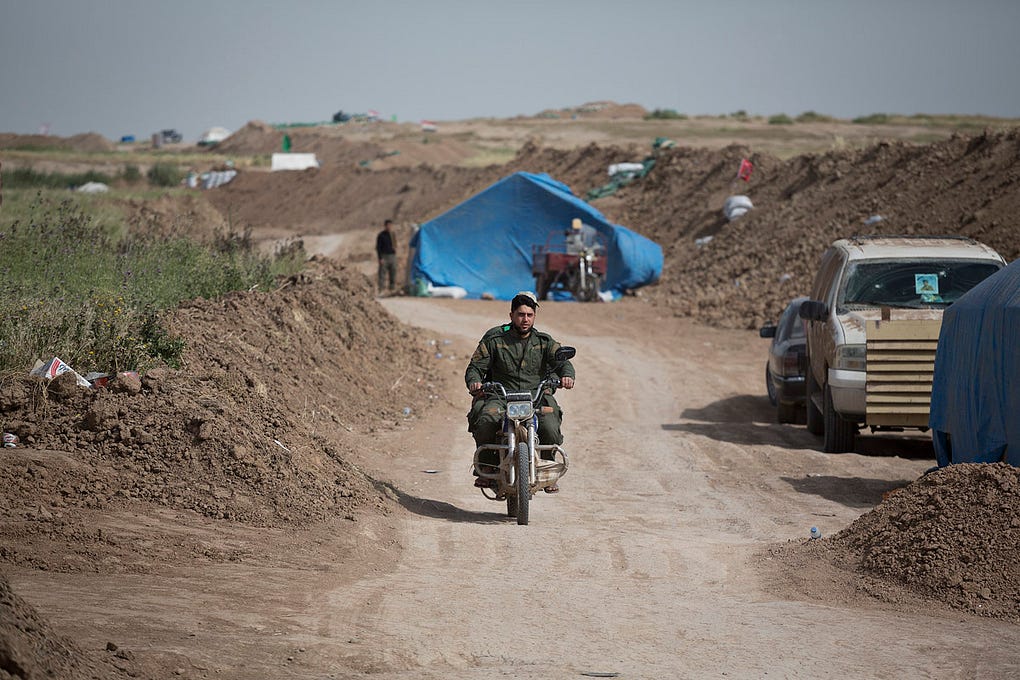
Two Turkmen fighters of the Badr Organisation ride a motorbike along the front line near Bashir. Matt Cetti-Roberts photo
Shaker Hassan Ali, a Turkman spokesperson for the Hashd Shaabi’s Badr Organization based in their Kirkuk offices has a … different take. He says that Islamic State dressed up as Popular Mobilization Troops and carried out looting as a form of disinformation.
“A man with Hashd Shaabi hasn’t seen his family, he is not going back to take things, he is going to fight and be a martyr — he’s not there to steal,” Ali says.
The Iraqi Shia Badr Organization is one of Iraq’s most powerful paramilitary groups. Originally set up in 1982 and — at that time — led by Iranian officers, they were accused of sectarian killings during the 2006–07 Iraqi civil war.
They now operate under the umbrella of the Hashd Shaabi. Shaker says they have around 5,000 fighters in the Kirkuk area and — he claims — even have Christians and Sunni among them.
“If there had been no fatwa in Iraq it would have been a bad situation,” Shakar says as he sits in a large hall in the Badr’s offices. Today, the organization is having a ceremony to remember one of their colonels who died fighting in Tikrit.
In the dim hall lit by fluorescent tubes, two portraits of a man wearing a uniform photoshopped onto an Iraqi flag sit on a table. His name was Qassim Avaf, a fighter who died in the Turkmen’s first attack on Bashir in June 2014.
The militia found his body in no-man’s land.
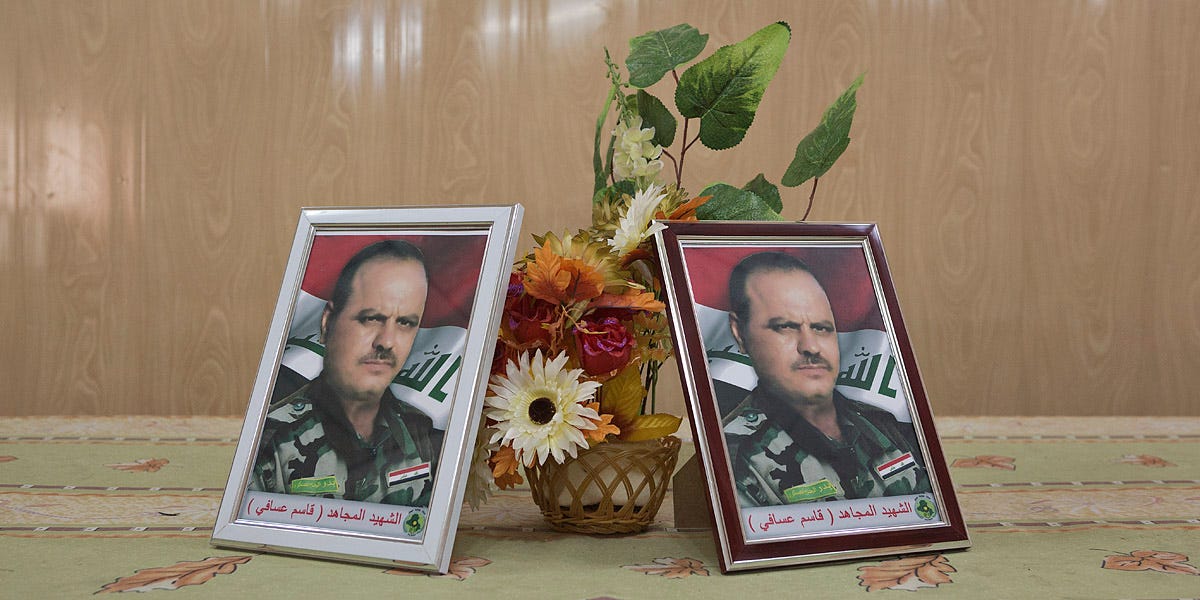
Two portraits of Qassim Avaf, a fighter who was killed in the first attack on Bashir in June 2014, are seen on a table in the Kirkuk offices of the Badr Organisation. Matt Cetti-Roberts photo
Another attack
Back at the front line, a group of fighters stand together. Another fighter named Abbas, an officer in charge of around 100 Turkmen, stands with a shotgun over his shoulder.
“Three were injured by mortars,” he says, referring to an Islamic State barrage earlier that day. “Since the first attack on Bashir, 64 fighters have been killed and 103 injured.”
Abbas points to his faith as one reason why he joined the Badr Organisation. But he says he wants to take back the town because it belongs to the Turkmen. “We will fight side-by-side to retake the town ourselves, but we need any help we can get, it’s just us on this front line.”
There haven’t been coalition air strikes on this part of the front line, and in Abbas’ opinion, the U.S.-led coalition only supports the Kurdish Peshmerga. The Badr Organization is one of several groups that the coalition does not support with air strikes because of their sectarian agenda, according to a senior coalition forces officer.
So why hasn’t the Hashd Shaabi taken back the town? Abbas replies frankly that there are too many IEDs.
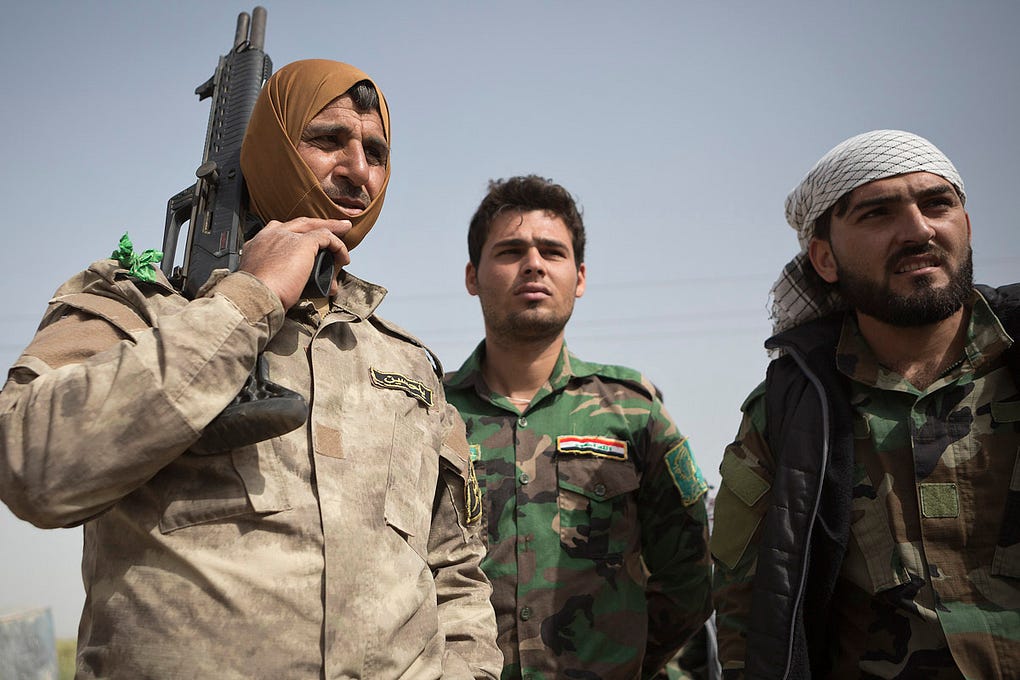
Shia Turkmen fighters, Abbas at left and Abu Mikhail at right, on the front line close to Bashir. Matt Cetti-Roberts photo
Another fighter, 24-year-old Abu Mikhail, left Bashir nine months ago when the town fell to Islamic State. A former carpenter, he joined the Badr Organization the same month.
“The call of fatwa made us join,” he says. “I fight first for faith, then for my country, and also for my brother who died fighting here to get Bashir back.” A few days after our interview, Abu Mikhail was killed when Islamic State detonated a large car bomb during the Turkmen’s attack on Bashir.
Nearly mile behind the Hashd Shaabi is another berm manned by Kurdish troops armed with ancient Soviet tanks and MTLB armored personnel carriers armed with 14.5-millimeter ZPU anti-aircraft guns.
Capt. Hider Sulaiman is a Peshmerga platoon commander. He stands near a T-62 tank.
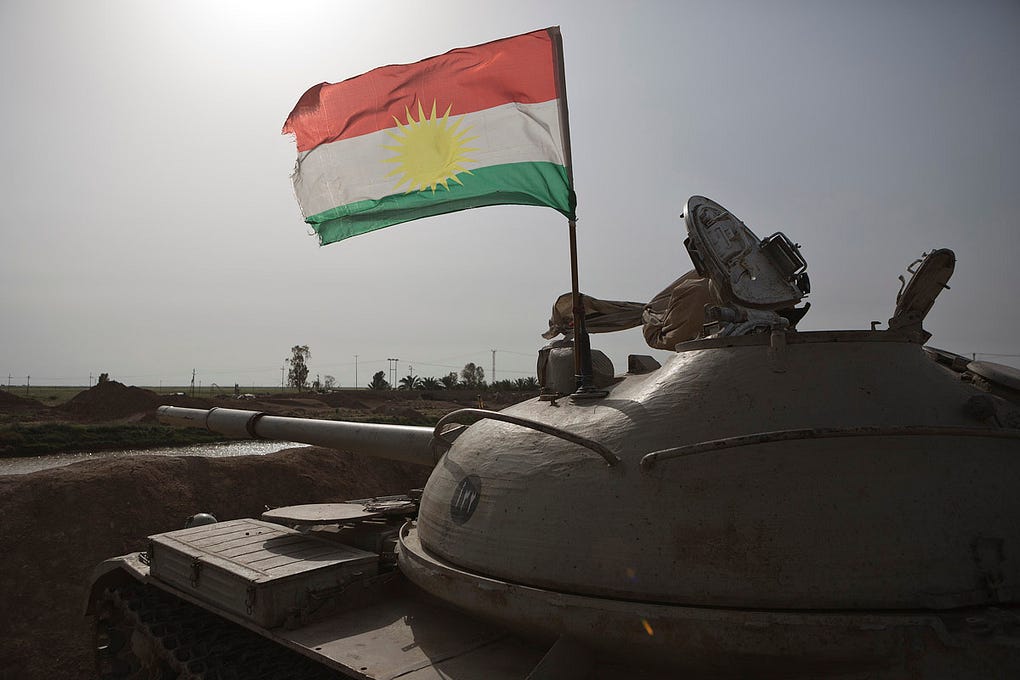
The flag of Kurdistan flies from the top of a Kurdish Peshmerga T-62 tank based at a support weapons line around a kilometer behind the Bashir front line. Matt Cetti-Roberts photo
“We work together on this front line,” Hider says.
He adds that both his unit — affiliated with the Kurdistan Democratic Party — and the Badr Organization communicate and work well together.
The presence of the KDP troops working with the Hashd Shaabi may be related to problems between the Popular Mobilization Forces and Peshmerga forces loyal to the Patriotic Union of Kurdistan — the political party that most of the units in this area belong to.
The Peshmerga are not here to take the village, but to support the Shia Turkmen fighters with heavier weaponry such as artillery. The village is Turkmen, so the job of taking it falls to the Hashd Shaabi.
Hider suggests that there may be as few as 50–60 Islamic State left in the town, and half of them could be snipers.
The militants in the town also use mortars to harass the Hashd Shaabi. “This morning they fired mortars. There is no pattern to their firing,” Hider explains. “Sometimes they shell at 2:00 a.m., sometimes 3:00 a.m., sometimes in the evening.”

Flags bearing names of those killed during the June 2014 attack on Bashir are seen on a wall in the nearby town of Taza. Matt Cetti-Roberts photo
The next attack would take place two days later. The fourth such assault on the town saw 400 Turkmen from all over Brigade 16 — bolstered by other Popular Mobilization forces from the rest of Iraq — attempt to reclaim the Turkmen town.
They failed.
IEDs caused the attack to stall and many — if not all — of the Islamic State insurgents were wearing suicide vests. The militants also drove a large car bomb at the attackers, causing multiple casualties.
The front line is now closer to Bashir, 30 meters in some places, but the town still remains in Islamic State hands.
Note: The article by Dr. Hassan Aydinli, Iraqi Turkmen Front EU Representative, about BASHEER has been posted on the European Parliament’s website:http://www.europarl.europa.eu/…/tragedyoftheturkmenpeop…
ORSAM REPORT ON AL -HASHD AL-SHAABI
May 29, 2015 at 8:18 am | Posted in Turkmens | Leave a commentORSAM REPORT
A NEW CONTROVERSIAL ACTOR IN POST-ISIS IRAQ : AL-HASHD AL-SHAABI
(THE POPULAR MOBILIZATION FORCES)
For the report please click on :
Create a free website or blog at WordPress.com.
Entries and comments feeds.
 EUROPE TURKMEN FRIENDSHIPS